- Publikationen
- Information & Analyse
- Pressemitteilungen & Stellungnahmen
- Berichte & Petitionen
- Informations- und Bildungsmaterialien
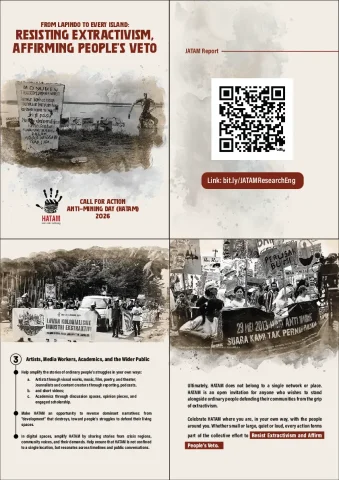
From Lapindo to Every Island: Resisting Extractivism, Affirming People’s Veto
Anti-Mining Day (HATAM) 2026
- Credit Daniel Stephanus
Credit to JATAM – as author
On 29 May 2006, the first eruption of the Lapindo mudflow occurred as a result of natural gas drilling operations conducted by Lapindo Brantas. Since then, the hot mud has continued to gush from the earth, submerging 16 villages across three sub-districts, destroying public infrastructure, and causing a massive ecological disaster.
Twenty years after the first eruption, the mud continues to flow, and the people of the district of Porong in Sidorjo, East Java, continue to live under the shadow of disaster. At the same time, similar patterns of dispossession are devastating communities affected by the extraction of resources such as nickel, coal,, milestone and gold, as well as National Strategic Projects (PSN) and so-called “green” energy projects across multiple islands.
Across Indonesia, from coastal villages to mountainous regions, from Indigenous forests to densely populated urban settlements, the expansion of mining and extractive industries continues to dispossess communities of their living spaces. In the name of development, downstream industrialization, energy transition, and the “national interest,” land is seized, water is contaminated, and the air is saturated with dust and smoke. Villages are forced to bear floods, landslides, mudflows, droughts, and fires they did not create.
Today, extractivism is not merely about mining pits. It is a mode of power that treats the earth, living spaces, and human bodies as raw materials to be extracted, exploited, and sacrificed for the benefit of a narrow political and economic elite. On paper, economic growth figures and commodity exports are celebrated. On the ground, however, communities lose their homes, farmland, water sources, health, and sense of security, while many are pushed to the brink of death.
Those who speak out—farmers, fishers, Indigenous peoples, workers, women, youth, and journalists—are often met with intimidation, criminalization, and violence. The state responds more swiftly to protect corporate concessions and assets than to uphold people's rights to land, water, and a healthy environment. This is the naked face of the extractive regime: elevating the interests of extractive industries into state interests while displacing the very communities defending their living spaces.
Yet amid this widespread destruction, something else continues to grow: the resistance of the people from all over the archipelago.
In many villages, residents refuse to sign coerced agreements. They block heavy machinery and hauling roads that cut through their communities, hang banners on excavators, drive away company vehicles, organize communal kitchens, attend and monitor court hearings, write petitions, build community media, produce films and murals depicting the wounds inflicted on their villages, hold people's stages and cultural events, and revive Indigenous rituals, collective prayers, and pilgrimages to ancestral graves as ways of building collective strength.
- Lutfi-Posko
By commemorating the tragedy of Porong, HATAM 2026 connects the wounds of Lapindo with those of other affected communities, making Porong a starting point for uniting lines of resistance from Sumatra, Java, Kalimantan, Sulawesi, Nusa Tenggara, Maluku, and Papua.
Through HATAM 2026, we reaffirm that communities have the right to determine the future of their territories and living spaces. We reject development models that sacrifice people and nature for profit, and we uphold the people's veto, the collective right of communities to say no to projects that threaten their lives, livelihoods, cultures, and environments.