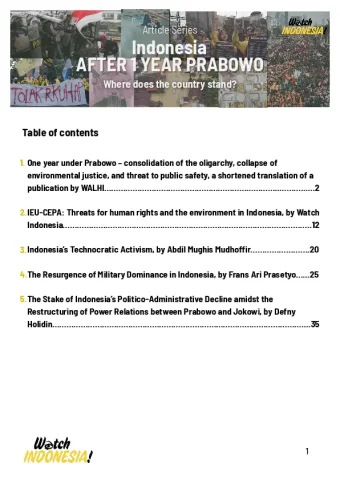
One year of Prabowo - Where does the country stand?
One year after President Prabowo Subianto took office, the political developments in Indonesia are cause for concern. Democracy continues to erode: power is increasingly concentrated in the executive, militarization is expanding, civil liberties are being restricted, and an effective political opposition is lacking, while social inequality is growing at the same time. In this series of articles, representatives of civil society organizations and scholars examine developments in the country with regard to democracy, human rights, and environmental protection.
The article One Year of Prabowo – Consolidation of the Oligarchy, Collapse of Ecological Justice, and Threats to Public Safety, an abridged translation of a publication by the Indonesian environmental organization WALHI, illustrates how the government is relying on economic growth through resource extraction, large-scale projects, and new debt, thereby exacerbating environmental destruction and social inequality. In particular, food-estate projects, the legalization of illegal palm oil plantations, and a new mining law are criticized because they destroy forests and displace Indigenous communities. WALHI also considers the so-called energy transition and climate policy to be lacking credibility, as Indonesia continues to rely on fossil fuels and large-scale industrial projects.
The global dimension of these developments is addressed in the article IEU-CEPA: Risks to Human Rights and the Environment in Indonesia by Watch Indonesia!, which examines the new trade agreement between the EU and Indonesia (IEU-CEPA) from a human rights and environmental perspective. The agreement threatens to further intensify the trend toward extractivism – for example through the expansion of palm oil plantations and nickel mining. These developments, facilitated by weakened environmental laws and regulations, are leading to increased environmental pollution, the exploitation of workers, and the criminalization of groups, especially Indigenous communities, that defend their land against mining and plantation projects.
In the article Technocratic Activism in Indonesia, Abdil Mughis Mudhoffir argues that protests against the authoritarian policies of Prabowo Subianto are growing, but remain politically ineffective because they are often spontaneous and leaderless. Many activists, he argues, view problems such as repression, corruption, or poor crisis management merely as technocratic mistakes and incompetence, instead of questioning the underlying power structures and elite interests. Mudhoffir describes this as “technocratic activism”: the hope that the state can be reformed through better laws, institutions, or individual “good” politicians. Instead, he argues that progressive forces must build their own political parties or organized movements in order to directly challenge state power and break the dominance of political and economic elites.
In his article ‘The Return of Military Power in Indonesia’, Frans Ari Prasetyo examines the resurgence and alarming expansion of military influence in civilian spheres following the amendment of the TNI Law (RUU-TNI) in 2025. Democratic civil society space is being suppressed, whilst the militarisation of everyday life continues. In protests across nearly 70 cities in Indonesia, demonstrators voiced their dissatisfaction and made clear demands of the government.
In Indonesia’s Politico-Administrative Decline amidst the Restructuring of Power Relations between Prabowo and Jokowi, Defny Holidin argues that President Prabowo has broken only little with the policies of his predecessor Joko Widodo, yet a power struggle between the two has become visible. Prabowo has adopted many projects and figures from the Jokowi administration, while simultaneously building his own power structures, for example by strengthening the military and weakening the police as Jokowi’s power base. The conflict between the military and the police is described as an institutional proxy struggle between the camps of Prabowo and Jokowi. Overall, Holidin argues, this development is leading to a further erosion of democratic oversight and a shift in Indonesia from a constitutional state toward a more authoritarian power state.